AGENT·EMILYB

Emily by Co-Desk
co-desk.eu
Voice AI copilot for coworking & coliving operators
AI Agentnofollowproduct_hunt
 MCP Hub
proof-of-execution for AI agents
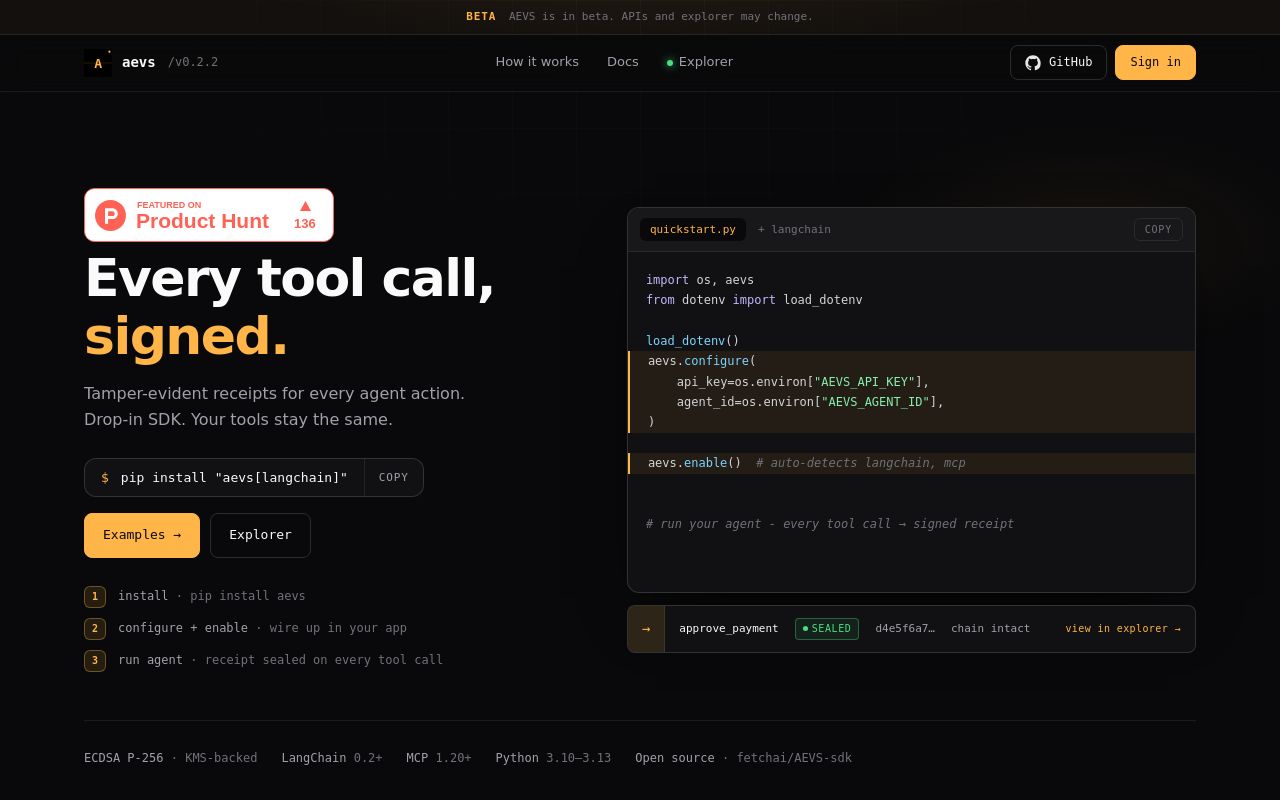
AEVS by Fetch.ai is a developer-focused tool designed to provide proof-of-execution for AI agents, ensuring verifiable and tamper-proof records of AI operations. With 136 votes on Product Hunt and active discussions in its 27-comment thread, AEVS targets developers building autonomous AI systems that require accountability and transparency. The platform operates within Fetch.ai’s ecosystem, leveraging blockchain technology to certify AI agent actions.
This guide explores AEVS’s commercial viability, core functionalities, use cases, evaluation criteria, alternatives, and FAQs—helping developers assess its fit for their projects.
AEVS is positioned as a B2B developer tool with moderate commercial intent (scoring 40/100). While it doesn’t disclose pricing or subscription models, its value proposition lies in enabling trust for AI agents in decentralized applications (dApps) and enterprise workflows. Key commercial indicators include:
- Domain Authority: AEVS’s website (aevs.fetch.ai) has a domain rating of 72, reflecting strong backlink equity from Fetch.ai’s established ecosystem.
- Developer Adoption: Engagement on Product Hunt (136 votes) suggests interest from AI/blockchain developers.
- Blockchain Integration: As part of Fetch.ai’s decentralized network, AEVS may appeal to projects requiring auditable AI operations, such as DeFi or supply-chain automation.
Unlike mass-market SaaS tools, AEVS caters to niche technical users—its commercial growth likely depends on Fetch.ai’s broader adoption.
AEVS provides an SDK and infrastructure to cryptographically verify AI agent actions. Key features include:
- Proof-of-Execution: Generates immutable records (e.g., on-chain hashes) confirming that an AI agent performed a task as programmed.
- Tamper-Evident Logs: Uses blockchain to prevent retroactive manipulation of agent outputs.
- Fetch.ai Integration: Designed for AI agents built on Fetch.ai’s framework, though it may support cross-chain use cases.
For example, an AI agent automating a supply-chain payment could use AEVS to prove it executed the transaction under predefined rules, reducing dispute risks.
AEVS can verify that AI-driven trading bots follow protocol rules, ensuring compliance without centralized oversight.
AI agents tracking shipments or triggering payments can use AEVS to document operational integrity, critical for multi-party logistics.
Devices making AI-based decisions (e.g., energy grids) benefit from tamper-proof execution logs for regulatory audits.
AEVS could certify that AI voting assistants or proposal evaluators operate transparently in decentralized organizations.
Developers assessing AEVS should consider:
- Does your project require provable AI execution?
- Are you already using Fetch.ai’s agent framework?
- AEVS is optimized for Fetch.ai’s ecosystem. Cross-chain support is unconfirmed.
- Blockchain-based verification adds latency. Evaluate trade-offs for real-time systems.
- As a Fetch.ai subproject, AEVS’s roadmap depends on the parent company’s priorities.
Offers verifiable off-chain computation for smart contracts but lacks AI-specific features.
Provides audit trails for automated contracts but focuses on security, not AI agents.
Teams could build in-house proof-of-execution using Ethereum or Cosmos SDKs, albeit with higher development costs.
Note: Outbound links from automated listings (e.g., directories) may usenofollow attributes, affecting SEO value.
Pricing isn’t public. Fetch.ai’s ecosystem often uses token-based models (e.g., FET tokens for network fees).
Its primary design assumes blockchain integration. Non-decentralized use cases may not benefit fully.
Traditional logs can be altered. AEVS uses cryptographic methods (e.g., hashing) to make logs immutable.
Unclear. Documentation suggests tight Fetch.ai integration, but cross-platform support isn’t highlighted.
Blockchain verification introduces latency. Test throughput for time-sensitive applications.
AEVS fills a unique niche for developers needing auditable AI agents. Its success hinges on Fetch.ai’s adoption, but for blockchain-native projects, it offers a specialized solution to trust challenges. For updates, monitor Fetch.ai’s official channels.
co-desk.eu
Voice AI copilot for coworking & coliving operators

socialecho.net
AI social media copilot for teams and agents

perplexity.ai
Run AI agents across your local files and apps on Windows