AGENT·EMILYB

Emily by Co-Desk
co-desk.eu
Voice AI copilot for coworking & coliving operators
AI Agentnofollowproduct_hunt
 MCP Hub
Turn any API into an MCP server for AI agents
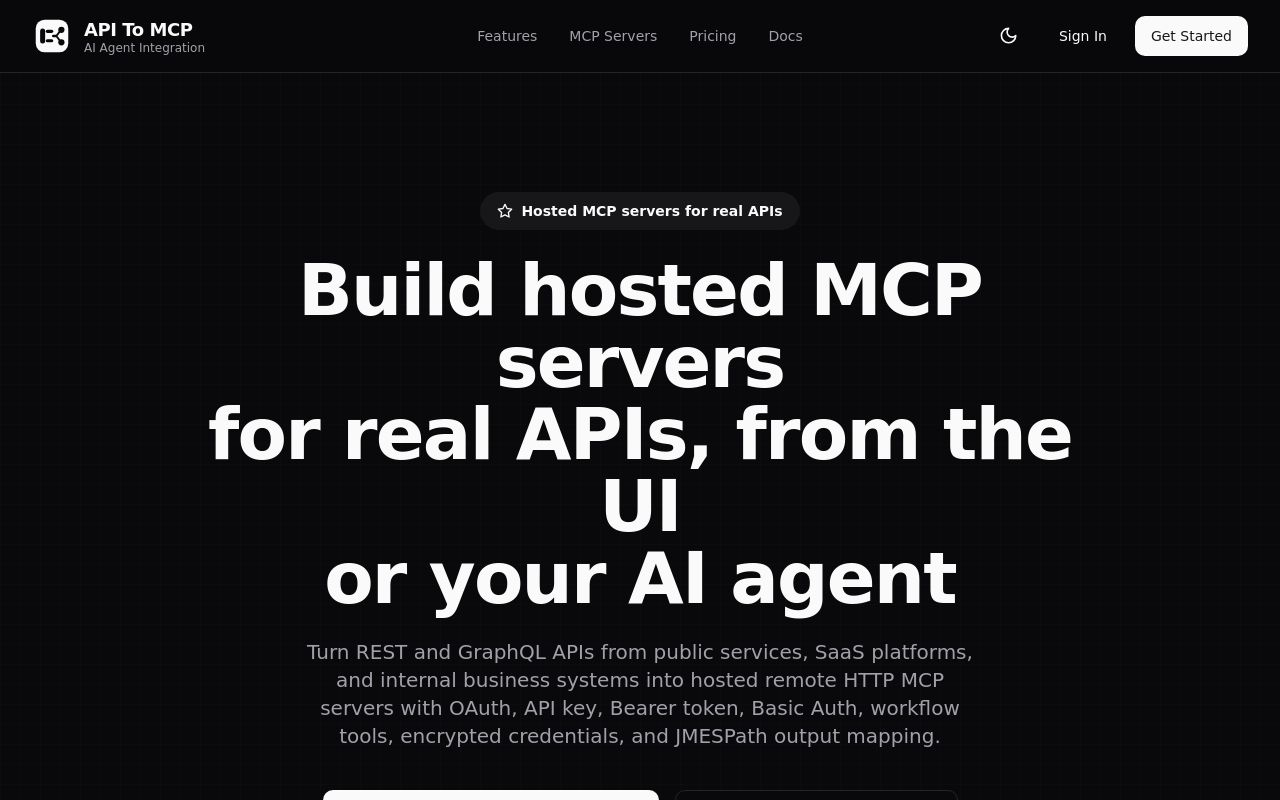
API to MCP is a developer-focused SaaS tool that bridges the gap between APIs and Multi-Component Programs (MCPs), enabling AI agents to interact with any API seamlessly. Designed for developers building AI-driven applications, this tool simplifies the process of converting RESTful APIs into MCP-compatible endpoints. With 196 Product Hunt votes and 29 comments, it has garnered attention in the AI and developer tools space.
Below, we explore its commercial potential, functionality, use cases, evaluation criteria, alternatives, and frequently asked questions.
API to MCP operates in a niche but growing market where AI agents require structured access to external APIs. Its commercial intent score of 20 suggests moderate monetization potential, supported by:
- Backlinks (14) – Indicates early interest from tech blogs and developer communities.
- Google Trends Status (OK) – Steady search interest in API-to-MCP conversions.
- Product Hunt Engagement (196 votes, 29 comments) – Strong initial reception among early adopters.
While the domain rating is currently low (0), the tool’s novelty and alignment with AI automation trends position it for growth. The website (apitomcp.ai) does not disclose pricing, but its Product Hunt presence suggests a freemium or subscription-based model.
For developers needing AI-agent-compatible API gateways, this tool reduces manual integration work, making it a viable commercial solution.
API to MCP converts standard REST APIs into MCP servers, allowing AI agents to interact with them programmatically. Key features include:
- API Transformation – Wraps existing APIs in an MCP-compatible layer, enabling AI agents to call endpoints without custom adapters.
- Standardized Protocols – Uses Multi-Component Program (MCP) standards to ensure interoperability with AI frameworks.
- Developer-Friendly – Designed for seamless integration with minimal code changes.
This tool is ideal for developers who want to:
- Expose internal APIs to AI workflows.
- Enable AI agents to fetch and manipulate data from third-party services.
- Reduce boilerplate code for API-to-agent communication.
By abstracting API complexities, API to MCP accelerates AI-driven automation projects.
- Integrate business APIs (CRM, ERP) with AI agents for automated data processing.
- Example: An AI agent pulls customer data from Salesforce via MCP, then generates personalized emails.
- Connect AI agents to payment gateways (Stripe), communication tools (Twilio), or analytics platforms.
- Example: An AI chatbot processes Stripe payments via an MCP-wrapped API.
- Expose legacy systems to modern AI agents without refactoring.
- Example: A manufacturing AI monitors inventory via an old ERP system’s newly MCP-enabled API.
- Speed up AI agent development by avoiding custom API parsers.
- Example: A developer tests a weather-based AI agent using a wrapped WeatherAPI.com endpoint.
These use cases highlight flexibility for both startups and enterprises adopting AI automation.
When assessing API to MCP, consider:
- Does it support your API’s authentication (OAuth, API keys)?
- Are response formats (JSON, XML) fully translatable to MCP standards?
- Latency introduced by the MCP layer should be minimal.
- Check for rate-limiting or throttling policies.
- Clear docs are critical for developer adoption.
- Community or paid support options may influence long-term viability.
- Can it handle high-throughput AI agent requests?
- Is there a tiered pricing model for growing usage?
- Ensure MCP endpoints inherit original API security measures.
- Look for audit logs or permissions controls.
These criteria help determine if API to MCP fits your technical and business needs.
- Pros: Full control over integration logic.
- Cons: Time-intensive to build and maintain.
- Pros: No-code automation for popular apps.
- Cons: Limited flexibility for custom APIs or AI agents.
- Pros: Unified querying for multiple APIs.
- Cons: Doesn’t natively support MCP standards.
- Pros: Vendor-provided libraries optimize performance.
- Cons: Requires per-service customization for AI agents.
API to MCP stands out for developers prioritizing MCP compatibility without building in-house solutions.
- The website doesn’t specify pricing. Check apitomcp.ai for updates.
- It should work with any RESTful API, but check documentation for edge cases.
- MCP is tailored for AI agents, while GraphQL focuses on flexible querying for UIs.
- Unclear; contact the team for deployment options.
rel="nofollow" for outbound links.
For more details, visit the Product Hunt page.
API to MCP fills a critical gap in AI agent development by simplifying API integrations. Its success hinges on developer adoption and scalability—factors to watch as the AI automation market grows.
co-desk.eu
Voice AI copilot for coworking & coliving operators

socialecho.net
AI social media copilot for teams and agents

perplexity.ai
Run AI agents across your local files and apps on Windows