AGENT·EMILYB

Emily by Co-Desk
co-desk.eu
Voice AI copilot for coworking & coliving operators
AI Agentnofollowproduct_hunt
 MCP Hub
Computational language built for humans and AI agents
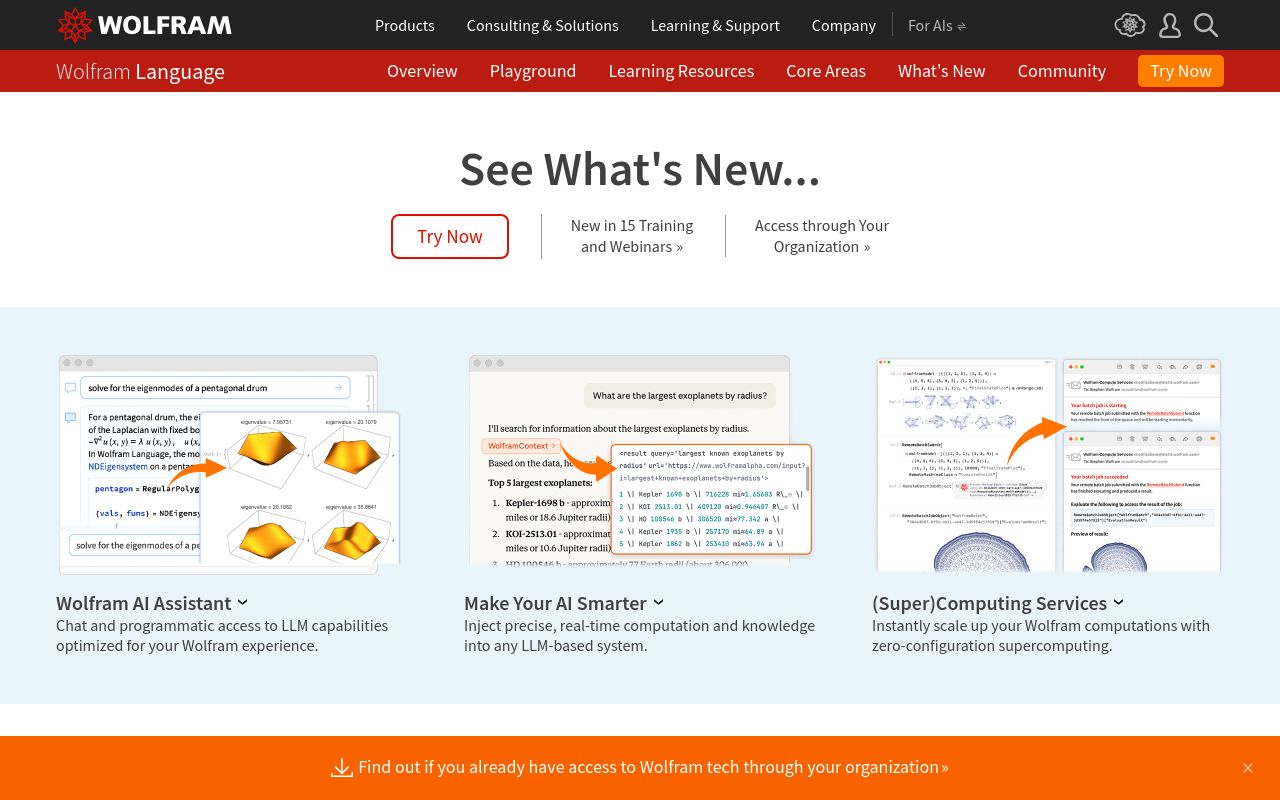
Wolfram Language 15 is a high-level, multiparadigm computational language designed for both human developers and AI agents. Developed by Wolfram Research, it integrates symbolic computation, functional programming, and rule-based programming to enable complex computations across scientific, mathematical, and AI-driven applications. With its latest iteration, Wolfram Language 15 introduces enhanced AI capabilities, improved performance, and expanded functionality for data science, machine learning, and automation.
This article explores the commercial intent behind Wolfram Language 15, its core functionalities, use cases, evaluation criteria, alternatives, and frequently asked questions.
Wolfram Language 15 serves a commercial audience, including enterprises, academic institutions, and AI developers. The product is positioned as a premium computational tool, backed by Wolfram Research’s long-standing reputation in mathematical and scientific computing.
Several indicators confirm its commercial viability:
- High Domain Authority (DR 86) – Wolfram.com is a trusted resource in computational science.
- Strong Backlink Profile (2,184,810 backlinks) – The language is widely referenced in academic and technical circles.
- Product Hunt Engagement (101 votes) – Demonstrates interest from developers and tech enthusiasts.
- Google Trends Stability – Consistent search interest over time.
Wolfram Research monetizes the language through licensing, including integrations with Mathematica and Wolfram|One, its cloud-based computational platform. While pricing is not publicly listed, enterprise and academic licensing models suggest a premium positioning.
Wolfram Language 15 is a symbolic computation engine that simplifies complex mathematical, scientific, and AI-driven tasks. Key features include:
- Performs exact arithmetic, algebraic manipulations, and calculus operations.
- Supports high-precision numerical computing for scientific research.
- Built-in neural network frameworks for training and deploying models.
- Pre-trained models for image recognition, natural language processing, and predictive analytics.
- Automated data wrangling with Wolfram Knowledgebase integration.
- Advanced plotting and statistical functions for exploratory analysis.
- Supports declarative programming for automation and AI agent scripting.
- Enables symbolic AI, where computations are treated as manipulable expressions.
- Seamless deployment via Wolfram Cloud and REST APIs.
- Interoperability with Python, Java, and other languages through Wolfram Client Library.
- Used in physics, chemistry, and engineering for symbolic equation solving.
- Facilitates reproducible research with notebook-based documentation.
- Simplifies prototyping for AI models with pre-trained networks.
- Supports reinforcement learning and automated theorem proving.
- Enables risk modeling, algorithmic trading, and actuarial computations.
- Integrates with real-time financial data sources.
- Scripts complex workflows in robotics, IoT, and industrial automation.
- Powers AI agents in decision-support systems.
- Teaches programming concepts through interactive notebooks.
- Used in STEM curricula for hands-on computational experiments.
When assessing Wolfram Language 15, consider the following factors:
- Steeper than Python or R due to its symbolic computation paradigm.
- Documentation is extensive but assumes some mathematical proficiency.
- Optimized for symbolic math, outperforming general-purpose languages in certain tasks.
- Cloud deployment enables distributed computing for large datasets.
- Works with Mathematica and Wolfram|One for enhanced functionality.
- Supports external libraries via Wolfram ExternalFunction.
- Not open-source; requires a paid license for full features.
- Free tier available with limited computational power.
- Strong academic and research community backing.
- Enterprise support available for commercial users.
- Open-source and widely adopted in AI and data science.
- Lacks native symbolic computation capabilities without additional libraries.
- Preferred in engineering and control systems.
- More expensive and less flexible for AI applications.
- Dominates statistical analysis and bioinformatics.
- Weak in symbolic computation compared to Wolfram.
- High-performance computing with a growing ecosystem.
- Still maturing in AI and symbolic math.
- Provides a GUI and additional tools but shares the same language core.
- More expensive than standalone Wolfram Language licensing.
No, it requires a license, though a limited free tier is available via Wolfram Cloud.
Yes, it includes neural network frameworks and pre-trained models for AI development.
Wolfram excels in symbolic math and integrated knowledge bases, while Python has a broader open-source ecosystem.
Yes, certain computations can be GPU-accelerated via CUDA and OpenCL.
Yes, it has built-in functions for REST API calls and web scraping.
Yes, via Wolfram Engine for Developers, which supports Jupyter notebooks.
Academia, finance, engineering, AI research, and government sectors.
nofollow for external links.
Yes, via Wolfram Cloud or embedded deployments in applications.
Yes, it includes constructs for parallel and distributed computing.
Wolfram Language 15 is a powerful, specialized tool for computational mathematics, AI, and scientific research. While its learning curve and licensing model may deter casual users, its symbolic computation strengths make it indispensable for researchers, engineers, and AI developers.
For those exploring alternatives, Python and Julia offer more open ecosystems, but Wolfram remains unmatched in integrated knowledge-based computing.
Explore more at the official website or its Product Hunt page.
co-desk.eu
Voice AI copilot for coworking & coliving operators

socialecho.net
AI social media copilot for teams and agents

perplexity.ai
Run AI agents across your local files and apps on Windows