CLI·TLDX4D listed

tldx
github.com
Fast CLI to bulk-check domains via RDAP & MCP
MCP Client CLI
 MCP Hub
Open-source platform for managing MCP servers and clients
Free listing links are nofollow. Owners can unlock a permanent dofollow backlink.
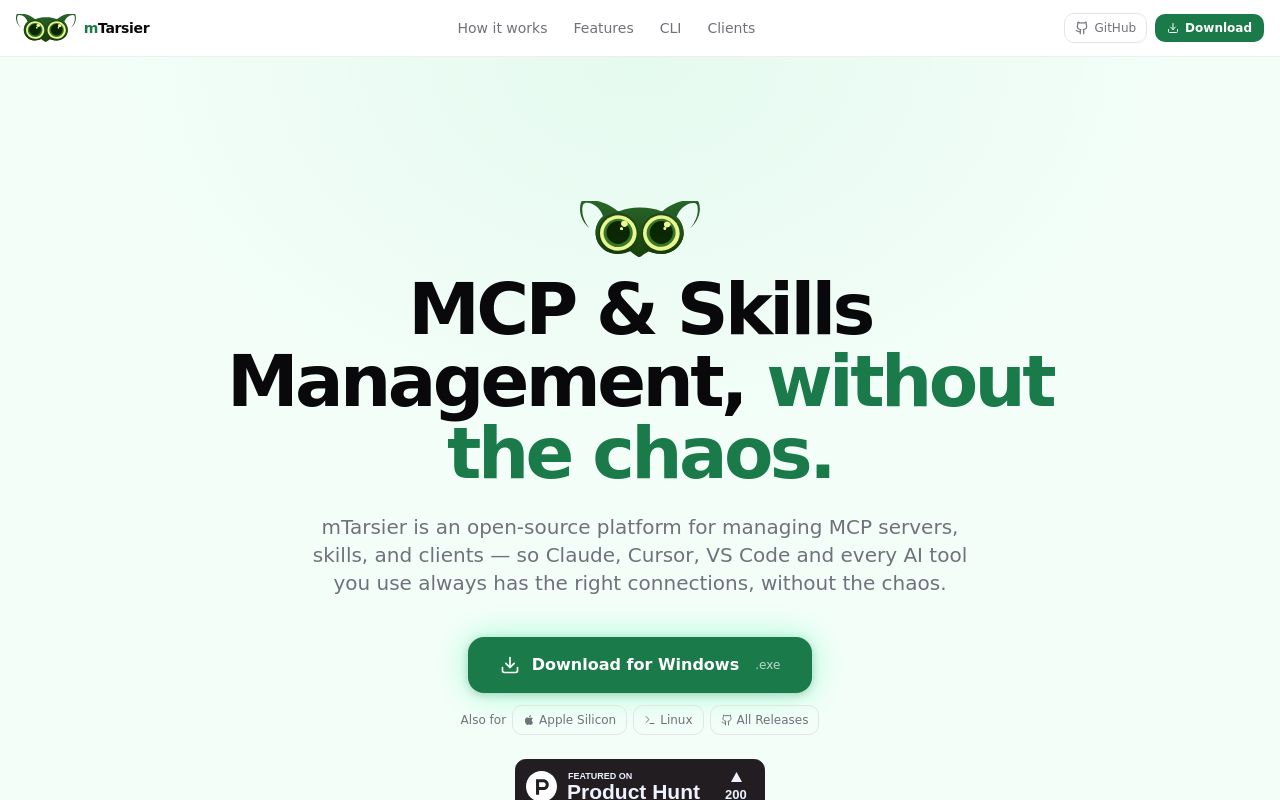
mTarsier is an open-source command-line interface (CLI) tool designed for developers and administrators working with MCP (Managed Compute Platform) servers and clients. As highlighted on Product Hunt, it simplifies the management, configuration, and automation of MCP environments. With 200+ upvotes and a growing community, mTarsier is gaining traction among AI and cloud infrastructure professionals.
This guide explores its features, installation, use cases, alternatives, and more—helping you decide if it fits your workflow.
mTarsier provides command-line control over MCP-based deployments, enabling users to:
- Automate server/client configurations – Deploy, scale, or modify MCP instances via CLI commands.
- Monitor performance – Retrieve logs, metrics, and status reports for debugging and optimization.
- Integrate with workflows – Script repetitive tasks or embed mTarsier in CI/CD pipelines.
Unlike proprietary tools, mTarsier is open-source (hosted on GitHub), allowing customization for specific MCP setups. Its lightweight design prioritizes speed and interoperability, making it ideal for DevOps teams managing distributed AI workloads.
Key features include:
- Multi-platform support (Linux, macOS, Windows via WSL).
- YAML/JSON configs for repeatable deployments.
- Plugin system for extending functionality (e.g., auth providers, logging modules).
mTarsier is available via direct download or package managers. The official website provides prebuilt binaries for:
- Linux (Debian/APT, Red Hat/RPM)
- macOS (Homebrew)
- Windows (WSL2 recommended)
For developers, building from source is supported (requires Go 1.20+).
After installation, verify functionality with:
mtarsier --version
Common workflows:
mtarsier auth login --server <mcp-host>
mtarsier client create --config client.yaml
mtarsier server status
Documentation includes examples for advanced scenarios, such as load balancing and auto-scaling.
mTarsier suits teams leveraging MCP for:
- Spin up GPU-backed clients for model training.
- Schedule batch jobs via CLI scripts.
- Replace manual server setups with declarative configs.
- Enforce compliance (e.g., auto-tagging resources).
- Unify control for on-prem and cloud-based MCP nodes.
- Sync environments using version-controlled configs.
For startups, the open-source model reduces costs versus SaaS alternatives. Larger enterprises benefit from auditability and custom plugins.
Consider mTarsier if you prioritize:
✅ Open-Source Flexibility – Modify or extend the tool freely (MIT License).
✅ CLI-First Design – Fits scripting and automation-heavy workflows.
✅ MCP Specialization – Tailored for Managed Compute Platform ecosystems.
Potential limitations:
❌ Steep Learning Curve – Requires familiarity with MCP architectures.
❌ No GUI – Not ideal for users reliant on visual dashboards.
| Tool | Type | Key Difference |
|---------------|------------|-----------------------------------------|
| MCP360 | Commercial | GUI dashboard, enterprise support |
| Kubemcp | OSS | Kubernetes-native MCP integration |
| Terraform | OSS | Broad infra support (not MCP-specific) |
Note: Outbound links from automated listings (e.g., Product Hunt) may usenofollow attributes per SEO guidelines.
Yes, it’s open-source under the MIT License. No paid tiers exist.
Primary development targets Unix-like systems, but WSL2 works. Native support is experimental.
mTarsier is CLI-driven and community-supported, whereas MCP360 offers proprietary GUI tools and SLAs.
Yes! The GitHub repo welcomes third-party modules for auth, monitoring, etc.
Final Verdict: mTarsier excels for developers needing granular MCP control via CLI. If you manage AI clusters or automate cloud deployments, it’s worth testing. For hands-off users, GUI-based alternatives may be preferable.
Open-source platform for managing MCP servers and clients
No verified install command is listed yet. Use the official project link or repository for setup instructions.
Open-source platform for managing MCP servers and clients
No verified install command is listed yet. Use the official project link or repository for setup instructions.